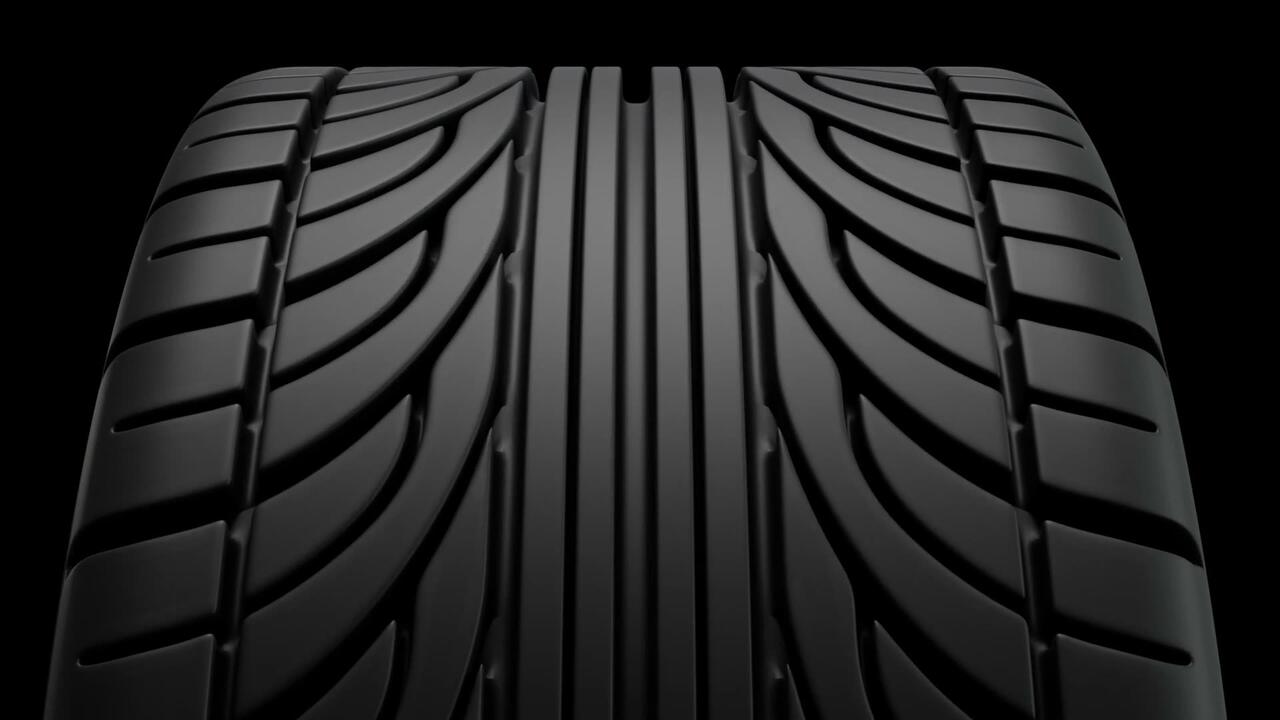

Most people ask for these two together and assume they're the same job. They're not — one moves your tires around the car, the other corrects the weight inside the wheel — and knowing which one your car actually needs saves you money. Here's the difference in plain English.
They're Two Different Jobs
They get bundled on the same invoice so often that the distinction gets lost. It matters, because they fix completely different problems.

Rotation Moves the Tires Around the Car
Your tires don't wear at the same rate. The driven wheels work harder, the front tires take the scrubbing from steering, and the weight distribution of the car is never even. Rotation moves each tire to a different corner on a set pattern so the wear spreads across all four instead of destroying two. Nothing is taken off the wheel — the tires just change places.

Balancing Corrects Weight Distribution in the Wheel
No tire and wheel assembly is perfectly even in weight. Spun up to highway speed, a heavy spot turns into a vibration you feel through the steering wheel or the seat. Balancing puts the assembly on a machine, finds the heavy spot, and counters it with small weights on the rim. It's about smoothness and about protecting your suspension — not about wear patterns.
How to Tell Which One You Need

Signs You're Due a Rotation
- Your front tires have visibly less tread than the rears, or the other way round
- One pair is wearing noticeably faster than the other
- You can't remember the last time they were rotated
- You've just passed the mileage interval since the last one

Signs You Need Balancing
- A vibration that shows up at a particular speed and eases off above or below it — often around 50 to 70 mph on Route 301 or the Beltway
- Buzzing through the steering wheel at highway speed
- Shaking through the seat or the floor rather than the wheel, which usually points at the rear
- A wheel that's just had a tire fitted, or that's lost a weight off the rim

If what you're feeling is a steady pull rather than a vibration, that's an alignment question, not a balancing one. Call us and we’ll point you in the right direction.
How Often Should You Rotate Your Tires?

Your vehicle manufacturer sets an interval and it's in your owner's manual — that's the number to work to, because it's specific to your car's drivetrain and weight distribution. As a habit, a lot of drivers tie rotation to an oil change so they don't have to remember a second schedule.

Balancing isn't on a fixed schedule the same way. You balance when there's a reason: a new tire has gone on, a weight has come off, or you've picked up a vibration that wasn't there before.

Not sure where you are? Call (240) 304-2968 with your mileage and what you're driving and we'll tell you.
What We Do
Rotation

We check tread depth at every corner first, so we can see what the wear pattern is telling us before we move anything.

We move the tires to the correct pattern for your vehicle — it's not the same for every drivetrain.

We check and set pressures, which differ front to rear on plenty of vehicles.
We flag anything the wear pattern has exposed. Uneven wear on one edge is an alignment symptom, and we'd rather you knew.
Balancing

The wheel and tire come off the car and go onto the balancer.
We spin it to find the heavy spot and measure how far out it is.
How A Balancer Finds The Heavy Spot
A wheel balancer on its bench. A 30 g heavy spot on a 0.2 m rim, turning as fast as it would at 60 mph, pulls on the spindle with about 43 N, 13.5 times a second, and the dial needle swings with that pull. The display reads the grams to add and where on the rim, as a clock position. A 30 g clip-on weight fitted opposite the heavy spot cancels the pull, and the needle settles at zero.
We fit corrective weights to the rim to counter it.

We recheck the spin and refit the wheel, torqued properly.
What It Costs
| rotation | Call for a quote |
|---|---|
| balancing | Call for a quote |
We quote both over the phone, since it varies with the vehicle. Call (240) 304-2968.
If you bought your tires from us, ask about rotation when you call — looking after a set we fitted is part of what you're buying.

How Long It Takes
Call (240) 304-2968 and we'll tell you how long to expect — a rotation, a balance, or both together, depends on the vehicle. You're welcome to wait.
Why It's Worth Doing

A set of four tires is real money, and rotation is the least expensive thing you can do to make that money last. Tires that never get rotated wear out in pairs — you replace two, then the other two a few months later, and you've paid for two trips and lost the benefit of even grip across the car in between.
Balancing is the other half of it. An out-of-balance wheel doesn't just annoy you at 65 mph, it hammers wheel bearings and suspension components and it scallops the tread on the tire itself. Both jobs are small. The bills they prevent are not.
If you're already at the point where the set is finished, ask us for a price when you call.
Rotation and Balancing Questions

Book It In
Call us with your mileage and what you're driving. We're at 6303 Crain Hwy, Upper Marlboro, MD 20772. We're open Monday to Friday, 8:00am to 7:00pm, and Saturday, 8:00am to 6:00pm.
(240) 304-2968 · 6303 Crain Hwy, Upper Marlboro, MD 20772
- Mon–Fri8:00 AM – 7:00 PM
- Sat8:00 AM – 6:00 PM
- SunClosed